
RESEARCH
Climate and Marine Environmental Lab (CaMEL Lab)
Trinity University
Central Texas Lake microbiota
The geology and climatology of Central Texas, coupled with a long-term growth in the population and new infrastructure, put extreme stress on the water resources in the area. Potential impacts on freshwater reservoirs include decreases in the availability of drinking water, more frequent and intense events such as flooding and droughts, increased water temperatures, altered food web and ecosystem dynamics, and intensification of saltwater contamination. The extent and direction of change on specific reservoirs requires localized observations of the climatic, hydrologic, chemical, and biological parameters. In this study, we compared the water chemistry, physical characteristics, and the assemblages of microbiota from two locations in Canyon Lake with disparate levels of direct human influence. We determined which variables correlated with one another and with human influence using principal components analysis.

Gulf of Mexico benthic foraminifera
The series of bays along Port Aransas within the National Estuarine Research Reserve (NERR) experience a range of environmental conditions in response to anthropogenic and climatic perturbations. Benthic foraminifera are at the base of marine ecosystems and their community assemblages can indicate ecosystem health and stress.
This research focuses on how small scale ecosystem changes reflect broader environmental resilience across periods of climatic and anthropogenic influence. We expect to see changes in foraminiferal assemblages and sediment characteristics in relation to hydrologic variables.


Undergraduate researchers.

Molly Ruby
Geoscience and Env. Studies '27

Monet Tabhan
Geoscience '27
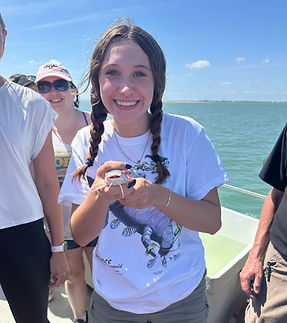
Kyra Balyeat
Accounting, Geoscience minor '27

Hanna Femmel
Geoscience '28

Laurel Griffin
Biology and Env. Studies '28

Linden Wheat
Geoscience '28
Beyond grad school
Northland College
As a Visiting Professor, there is not much time or opportunity to establish a productive research lab, but I have been able to supervise undergraduate students on thesis projects, and delve into geoscience education research as well! The undergraduate senior thesis projects have been student-led and have included 1) mapping the height and width ratios of glacial kettles on Bayfield Peninsula, and 2) creating a 3-D ArcScene map of the depth of the Miller Creek formation in Ashland County, WI.
In addition, an undergraduate geoscience major completed a semester-long independent study project focused on assessing the accessibility of the Geoscience Major curriculum at Northland College. The results from this project will be presented at the Ocean Sciences meeting in 2024.

UC Davis
Ph.D., Earth and Planetary Science
For my PhD, I generally focused on using the geochemistry of planktic foraminifera for reconstructing deglacial ocean conditions in the northern high-latitude oceans. I used the species Neogloboquadrina pachyderma, and aimed to answer questions such as: what is controlling the geochemistry of N. pachyderma calcite, where are these foraminifera living and calcifying, can we use multiple proxies within single shells to reconstruct temperature/salinity/runoff conditions, and how can this species be used in paleoceanographic studies? My research included culturing live planktic foraminifera at the Bodega Marine Lab for proxy calibration, and use of various analytical methods (i.e. LA-ICP-MS, SIMS, EPMA, IRMS) for geochemistry.

Presenting some of my research at the International Conference of Paleoceanography in Utrecht, Netherlands
Penn State
Masters of Science
I completed a MS in Geology studying planktic foraminifera species assemblage, diversity, and morphology across the PETM in cores from the Atlantic coastal plain.

Visiting a terrestrial outcrop of the PETM in Gubbio, Italy.
Hamilton College
Senior Thesis
I completed a science education senior thesis with Dr. Cindy Domack where I created a laboratory exercise utilizing fossil fish from the Green River Formation. The laboratory exercise was used in the introductory Paleontology course at Hamilton College. Research was presented at the Northeast GSA conference in Hartford, CT in Spring 2012.
